
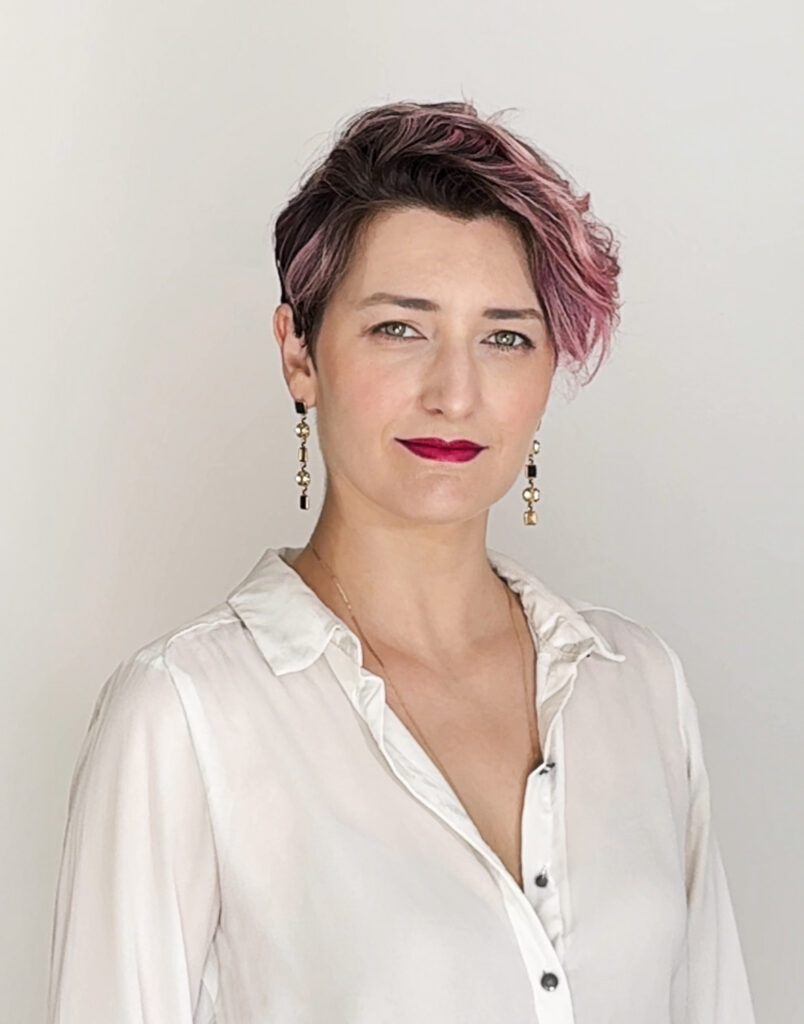
Tâmisa trommer
Visual Artist | Based in Italy
Bio
Born in 1985 in Brazil and based in Bergamo/Italy, Tâmisa Trommer is a visual artist whose research explores the relationship between memory, geographical displacement, and nature. Based in Bergamo, Italy since 2022, she develops a practice that engage with local flora and life cycles in contexts of cultural transit. Working across analogue and digital techniques, her compositions are marked by a sensorial approach to color, with a focus on processual time and sensitive documentation.
She holds a BA in Visual Arts from UFSM, with a specialization in Surface Design, a Master’s in Design, and is currently pursuing a Master’s in Painting at Accademia di Belle Arti G. Carrara. Her work has been shown at institutions such as Centro Cultural São Paulo, SESC Avenida Paulista, and Centro de Cultura Mário Quintana, as well as in biennials in Brazil and abroad.
Tâmisa trommer
Visual Artist | Based in Italy
bio
Tâmisa Trommer (b. 1985, Brazil) is a visual artist whose research explores the relationship between memory, geographical displacement, and nature. Based in Bergamo, Italy since 2022, she develops a practice that engage with local flora and life cycles in contexts of cultural transit. Working across analogue and digital techniques, her compositions are marked by a sensorial approach to color, with a focus on processual time and sensitive documentation.
She holds a BA in Visual Arts from UFSM, with a specialization in Surface Design, a Master’s in Design, and is currently pursuing a Master’s in Painting at Accademia di Belle Arti G. Carrara. Her work has been shown at institutions such as Centro Cultural São Paulo, SESC Avenida Paulista, and Centro de Cultura Mário Quintana, as well as in biennials in Brazil and abroad.
Statement
My practice investigates the transience of life, memory, and how we perceive plant life through image-making.
I work with photography, printmaking, painting, drawing, and video, combining traditional and experimental techniques to build compositions based on botanical elements. By enlarging plants in scale and detail – collected from urban and transitional zones – I aim to create a visual confrontation that brings attention to what is often overlooked, discarded, or misunderstood.
Each specimen I work with is directly tied to personal geography: plants gathered along the paths I walk, the places I live, or those that find me by chance. They carry material memory – of sunlight, lifespan, and environmental conditions – and bear witness to their surroundings. My interest is not in cataloging these plants, but in placing them at the center of the image – as botanical portraits that shift focus from the human subject to plant life itself. By interrupting their decomposition process, I propose a symbolic field of resistance to the logic of disposal.
I avoid the use of green to challenge conventional representations of nature and landscape, and promote a more critical, non-anthropocentric gaze. I see this work as part of a broader need to reframe how we recognize, relate to, and coexist with what grows around us, sand proposes, in response, a field of reconciliation between nature and culture.